Why Your Best Ideas Disappear in Traditional Productivity Tools

Planelo Team
We’ve all been there: you have a brilliant insight while standing in line for coffee. You quickly pull out your phone, open your note-taking app, and type it i…
We’ve all been there: you have a brilliant insight while standing in line for coffee. You quickly pull out your phone, open your note-taking app, and type it in. You feel a sense of relief—the idea is "safe." But a week later, when you actually have time to work on it, you can’t find it. You search for keywords, you scroll through folders, but it’s gone. Or worse, you find it, but the spark is gone. It’s just a cold, lifeless sentence that no longer makes sense.
I’ve spent years investigating why we keep losing ideas even though we have more "productivity" tools than ever before. It’s a frustrating paradox: the more we capture, the less we seem to use. I believe the reason is that most tools are designed for storage, not for retrieval or inspiration. They are digital attics where we store our thoughts, only to never look at them again.
The real problem: Retrieval vs. Visibility
The core issue with most productivity tools is that they rely on "retrieval" rather than "visibility." In a traditional folder-based system, an idea is hidden the moment you save it. It’s tucked away in a sub-folder, out of sight and out of mind.
Most tools get this wrong because they assume we will remember to go looking for our ideas. But the human brain works on triggers. If we don't see an idea, we don't think about it. We are effectively burying our sparks under a mountain of digital paperwork. When we talk about
Why this happens: The obsession with "Clean" UI
Industry patterns have moved toward a very specific type of "minimalism" that actually hurts creativity. We want our apps to look clean, so we hide everything behind menus, sidebars, and nested folders. We’ve optimized for a "clean desk" feeling at the expense of a "working studio" feeling.
Furthermore, many apps are built on the model of a document. They treat every thought like a file that needs a name and a location. This is great for an HR department managing contracts, but it’s terrible for a founder trying to connect the dots between a market trend and a product feature. We are losing ideas because our tools treat them as static objects rather than living thoughts that need to be seen to stay alive.
What works better: Low-friction visibility
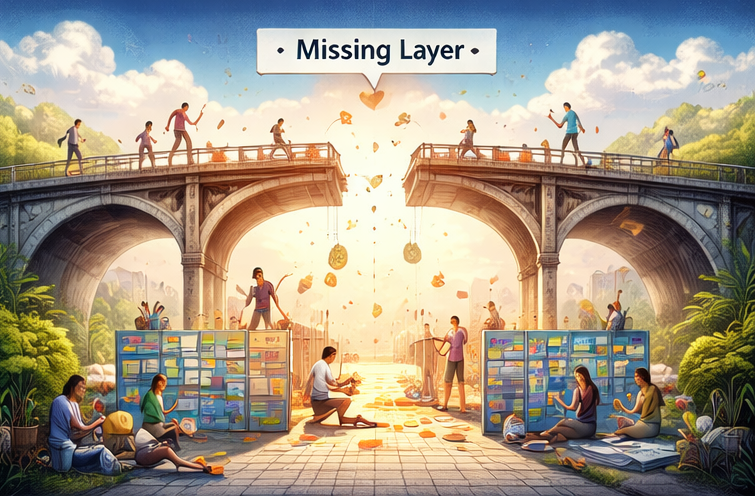
What works better is a system where your ideas remain "on the surface." Think of a physical corkboard versus a filing cabinet. On a corkboard, everything is visible. You can see the connections. You can see the "mess," but that mess is what leads to breakthroughs.
An alternative mindset is to prioritize "access" over "organization." Use tools that allow you to see multiple notes at once, or that surface old ideas randomly. Instead of trying to build a perfect archive, try to build a "stream." When you reduce the friction of seeing your ideas, you stop losing them. You don't need to remember where you put them because they are always right there, part of your daily digital environment.
How I approach this (founder POV)
I used to be a "folder addict." I had a folder for everything. But I realized I was using those folders as a way to "hide" from my ideas. If an idea was in a folder, I didn't have to deal with the fact that I hadn't started it yet. I was using my tools to archive my potential rather than to realize it.
When I designed the core experience of Planelo, I wanted to fight this "out of sight, out of mind" problem. I wanted a way to keep ideas visible without them feeling overwhelming. I realized that the reason I was losing ideas wasn't because I was forgetful, but because my tools were too good at hiding things from me. By moving away from deep hierarchies and focusing on a more fluid, visible interface, I started actually using the things I captured. My ideas stopped being "stored data" and started being "active ingredients" in my work.
Practical takeaway
If you feel like your best thoughts are disappearing into a black hole, try these tactics:
The "No-Folder" Challenge: Try using a single list for all your notes for one month. Use search and date-sorting instead of folders.
Weekly Surface: Set a recurring task to scroll through your "uncategorized" notes for 10 minutes every Sunday.
Keep it Short: Don't write essays. Write "atomic" notes. The smaller the note, the easier it is to review and connect to others.
Visual Cues: If an idea is really important, put it in a place where you must see it every day—like your desktop wallpaper or a physical sticky note on your monitor.
Conclusion
A tool should be a bridge to your work, not a warehouse for your thoughts. If you find yourself constantly searching for things you know you wrote down, the problem isn't your memory—it’s your system. We need to move away from tools that prioritize storage and move toward tools that prioritize presence. Your ideas are too valuable to be filed away and forgotten. Keep them close, keep them visible, and they will eventually turn into something real.