Why Most Idea Management Apps Fail Before the First Project

Planelo Team
I have a digital graveyard on my hard drive. It’s filled with accounts for dozens of different apps, each one once promising to be the "ultimate home" for my t…
I have a digital graveyard on my hard drive. It’s filled with accounts for dozens of different apps, each one once promising to be the "ultimate home" for my thoughts. I remember the excitement of signing up for a new tool—the clean interface, the empty folders, the feeling that this time, I would finally stay organized. But usually, within two or three weeks, the excitement faded. The app became a chore, then a source of guilt, and finally, just another icon I eventually deleted.
As a founder, I’ve spent a lot of time thinking about why this happens. Why do so many idea management apps feel like they are working against us rather than with us? We live in an age where capturing information is easier than ever, yet turning those captures into something real—a project, a product, a piece of writing—feels harder than ever. I want to explore why the current approach to managing ideas is fundamentally broken for many of us.
The real problem: Management as a distraction
The core issue with most tools is right there in the name: management. Most apps are designed to help you categorize, tag, color-code, and file away your thoughts. They treat ideas like administrative data that needs to be processed.
When we find a new tool, we often spend the first few days setting up the "perfect" system. We create complex folder structures and define dozens of tags. This feels like work. It feels productive. But in reality, it’s a form of sophisticated procrastination. We are managing the idea instead of developing it. Most tools get this wrong by forcing us into "librarian mode" when we should be in "creator mode." By the time we’ve finished organizing the shelf, the spark of the idea has often gone cold.
Why this happens: The friction of structure
There is a psychological reason why these systems fail. Our brains don't think in folders or nested hierarchies. Thoughts are messy, non-linear, and interconnected. When you have a sudden insight while walking or drinking coffee, the last thing you want to do is decide whether it belongs in "Folder A" or "Subfolder B," or which five tags you should apply to it.
The industry pattern has been to add more features to solve this—more automation, more AI, more complex linking. But more features usually mean more friction. Every extra click required to save a thought is an opportunity for that thought to vanish. We’ve been conditioned to believe that if we just find a "powerful" enough tool, our creativity will follow. But creativity doesn’t need power; it needs a lack of resistance. Most idea management apps create a barrier of entry that our creative minds eventually learn to avoid.
What works better: Space over structure
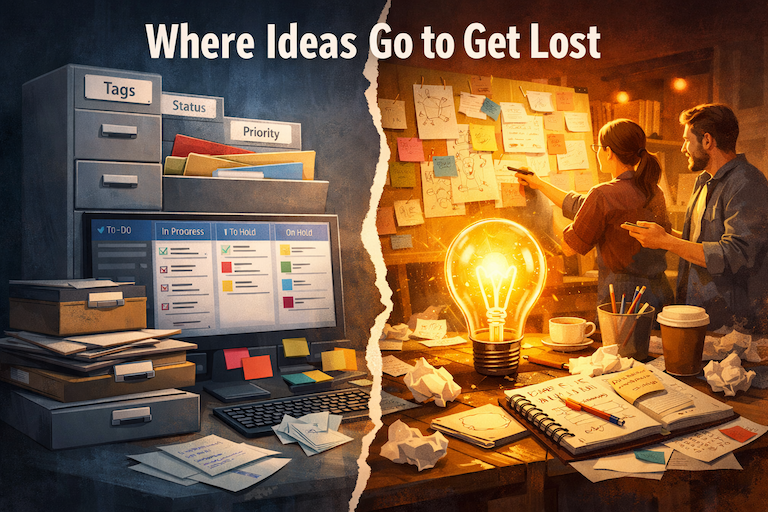
I’ve realized that the most successful "system" isn't a system at all—it’s a space. Think of the difference between a filing cabinet and a workbench. A filing cabinet is where things go to be stored (and often forgotten). A workbench is where things are active, messy, and within reach.
What works better is prioritizing "speed of capture" and "ease of review" over organization. An alternative mindset is to stop worrying about where an idea lives and start focusing on what the idea is. If you can get a thought down in two seconds without making a single organizational decision, you’ve protected the most fragile part of the creative process. You don't need a map of your ideas; you need a way to see them clearly so you can decide which one to act on next.
How I approach this (founder POV)
Building my own tools taught me that I had to unlearn everything I knew about productivity software. I used to be obsessed with "Total Knowledge Management." I wanted a system that could hold everything. But the more I added, the less I did. I was building a museum of my own thoughts, not a factory for my projects.
Now, my philosophy is "idea-first, project-second." I treat every note as a temporary guest until it proves it has the potential to become a project. This shift changed everything for me. It’s the reason I started building Planelo—I wanted a place where I could just let ideas exist without the pressure of immediately turning them into a task or filing them into a category. I needed a tool that felt as fast as a scrap of paper but as persistent as a database. It's about giving an idea room to breathe before you try to "manage" it.
Practical takeaways
If you find yourself constantly switching apps or feeling overwhelmed by your notes, try these shifts in your routine:
The Two-Second Rule: If it takes more than two seconds to start writing an idea down, the tool is too slow. Find the path of least resistance.
Audit Your Folders: If you have more than five main categories, you’re probably over-organizing. Try a flat structure where everything is visible or searchable.
The "So What?" Review: Once a week, look at your captured ideas. If you can't explain why an idea is interesting in ten seconds, delete it. Keep the signal high.
Separate Capture from Curation: Never try to organize an idea at the moment you have it. Capture it now; decide where it fits (if anywhere) later.
Conclusion
We don't fail our tools; often, our tools fail our humanity. We are not machines designed to process data; we are people trying to make sense of the world and build things that matter. The goal of any tool should not be to help you manage a thousand ideas, but to help you finish one project.
Next time you feel the urge to overhaul your entire organization system, ask yourself if you’re doing it because you need it, or because it’s easier than starting the hard work of creating. Sometimes, the best way to manage an idea is simply to start working on it.