Overcoming the Fear of Shipping: Why I Almost Didn’t Launch

Planelo Team
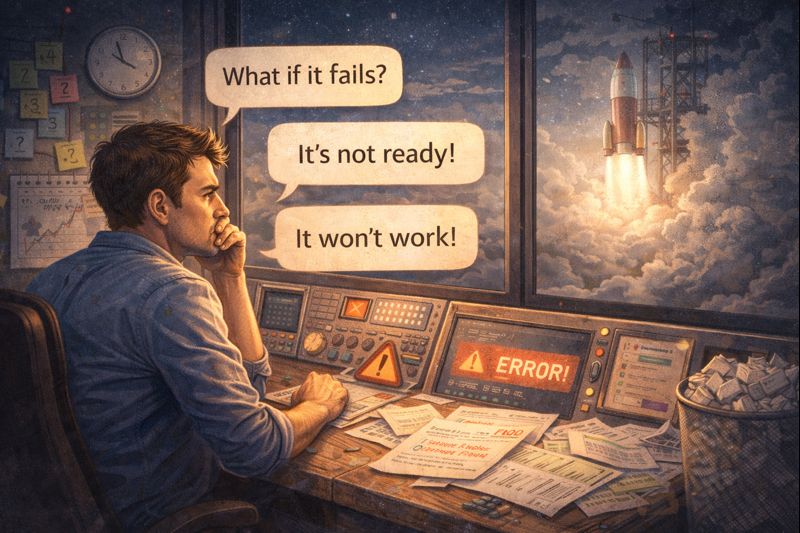
I remember the exact moment I was supposed to hit the "Submit" button on Product Hunt. It was 3:00 AM, my heart was racing, and my hand was literally shaking o…
I remember the exact moment I was supposed to hit the "Submit" button on Product Hunt. It was 3:00 AM, my heart was racing, and my hand was literally shaking on the mouse. Everything was ready—the screenshots were uploaded, the copy was written, the servers were scaled. But I couldn't do it. I closed my laptop, sat in the dark, and told myself that the "timing wasn't right."
I spent another two weeks "polishing" things that didn't need polishing. The truth is, I wasn't improving the app; I was hiding. I was experiencing a profound fear of shipping that nearly killed Planelo before it ever had a single user. As a solo founder, your product is your baby, and the thought of putting it out into the world to be judged, criticized, or ignored is terrifying.
The real problem: Perfectionism as a shield
The real problem isn't that we are "lazy" or "not ready." The problem is that we use perfectionism as a psychological defense mechanism. As long as the product is "in progress," it can still be anything. It has infinite potential. But the moment you ship it, it becomes a real, limited thing. It can be measured. It can fail.
Most tools and productivity methods get this wrong by focusing on "efficiency" and "task management." But for a founder, the bottleneck isn't usually time—it's courage. We struggle with shipping because we’ve tied our self-worth to the reception of our work. We think that if the launch fails, we are failures. This is why we fall into the
Why this happens: The visibility of the solo founder
In a large company, a product failure is spread across dozens of people. When you are a solo founder, there is nowhere to hide. You are the designer, the coder, and the support agent. This high level of personal visibility creates an intense founder mindset of hyper-vulnerability.
Industry patterns don't help. We are constantly exposed to the "survivorship bias" of the tech world. We only see the top 1% of launches that go viral. We don't see the thousands of great products that started with three users and a lot of bugs. This creates an unrealistic standard in our heads. We feel like if we don't have a "perfect" debut, we’ve lost our only chance. We forget that building a product is a marathon, not a sprint.
What works better: Shipping for the "version 10" you
What works better is a shift in perspective: you aren't shipping for today; you are shipping so you can reach "Version 10" in the future. You cannot reach the great version of your product without passing through the "okay" version first. An alternative mindset is to treat your launch as a data-gathering exercise, not a performance.
Practical examples of this include "low-stakes launches." Instead of a big announcement, just post a link in a small community. Or, better yet, set a "hard deadline" with a friend who will hold you accountable. The goal is to lower the "perceived stakes." Realize that even if your launch is a total "flop," the world keeps spinning, and you’ll have more information than you did yesterday. In fact, most of the
How I approach this (founder POV)
What finally got me to ship Planelo was a realization: I was being selfish. By keeping the tool to myself, I was denying potential users a solution to their problem just so I could protect my own feelings. I realized that my fear of being judged was less important than the value I was trying to create.
I had to adopt a new founder mindset: "Done is better than perfect, and shipped is better than done." I eventually hit that button not because I felt "ready," but because I felt "done with the fear." Now, I use Planelo itself to manage this anxiety. When I have a new feature idea that scares me, I capture it, let it sit for a day, and then force myself to ship the smallest possible version of it within 48 hours. I’ve learned that the only way to kill the fear is to take the action that causes it.
Practical takeaway
If you are paralyzed by the thought of launching, try these mental shifts:
The "Nobody Cares" Mantra: Remind yourself that most people won't even notice your first launch. This is a good thing. It gives you room to fail and iterate quietly.
Ship to One Person: Instead of "The World," ship to one specific person you trust. Get their feedback, fix one thing, and then ship to two people.
Set a Non-Negotiable Date: Pick a date, tell your audience (or just a friend), and commit to shipping whatever you have on that day. No excuses.
Focus on the Problem, Not the Product: When you focus on the person you are helping, your own ego-driven fear tends to fade into the background.
Conclusion
The fear of shipping never truly goes away; you just get better at moving in spite of it. Every great product you use today was once a "buggy" V1 that a founder was terrified to release. Don't let your fear rob the world of your ideas. Hit the button, embrace the feedback, and remember that the real work only starts after you ship. The most important feature your app can have is being available to users.