Idea-First vs Project-First Thinking: Why the Distinction Matters for Creativity

Planelo Team
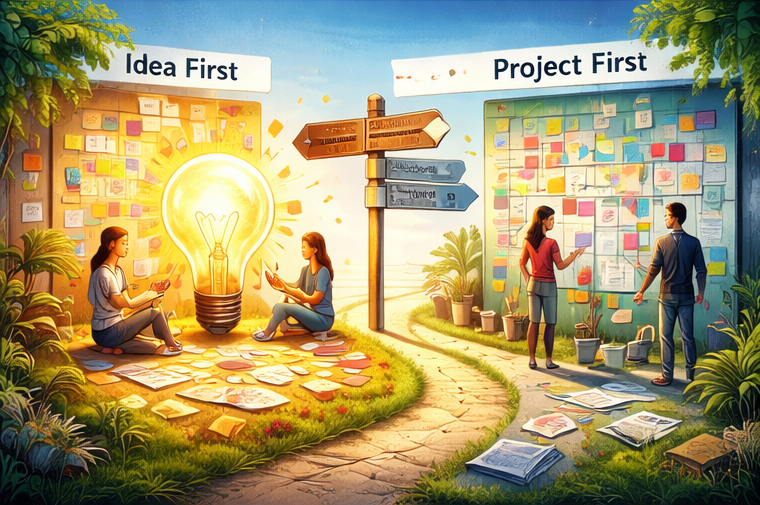
I used to start every new idea by creating a new project in my task manager. I’d give it a name, set a deadline (usually an arbitrary one), and start listing o…
I used to start every new idea by creating a new project in my task manager. I’d give it a name, set a deadline (usually an arbitrary one), and start listing out the "next steps." It felt professional. It felt like I was being a "serious" founder. But more often than not, those projects would sit there, gathering digital dust, until I eventually felt so guilty looking at them that I’d delete the whole thing.
The problem wasn't my work ethic; it was my mental model. I was practicing "project-first thinking," treating every spark of an idea as if it were already a committed obligation. I’ve since learned that there is a massive, crucial difference between idea vs project management, and confusing the two is the fastest way to kill your creative momentum.
The real problem: Turning play into work too soon
The real problem is that project management is about constraints. It’s about deadlines, resources, and specific outcomes. It is, by definition, a restrictive process designed to get you to a finish line.
When you move an idea into a project management system too early, you apply those constraints prematurely. You stop asking "What is this?" and start asking "When will this be done?" Most tools get this wrong by treating every entry as a "task." But an idea isn't a task. A task is "buy milk." An idea is "maybe there’s a better way to help people manage their thoughts." By turning an idea into a task, you strip away the playfulness and curiosity that the idea needs to grow.
Why this happens: The efficiency trap
We fall into this trap because our culture worships efficiency. We are told that "an idea without a plan is just a dream," so we rush to make a plan. We use tools built for industrial-era management to handle modern-era creativity.
Industry patterns favor project-first tools because they are easier to sell to teams and managers. They look organized. They have charts and progress bars. But these features are designed for execution, not exploration. We’ve been led to believe that if we aren't managing a project, we aren't being productive. In reality, the most valuable part of the creative process happens in the "pre-project" phase—the phase where you are just playing with possibilities without the pressure of a deadline.
What works better: The "Idea-First" workflow
What works better is a clear separation of church and state: keep your ideas in one place and your projects in another. An alternative mindset is to stay in "Idea-First" mode as long as possible.
In an idea-first workflow, you don't worry about deadlines or milestones. You focus on the "signal." You let the idea evolve, adding bits of research, random thoughts, and connections over time. You only move it into a project management system when the idea has become so clear and so urgent that it demands to be built. This prevents the "clutter of half-baked projects" that plagues so many of us. It allows you to
How I approach this (founder POV)
Changing my perspective from "managing projects" to "nurturing ideas" was the single biggest shift in my productivity as a founder. I realized that my task manager should be a very small, very focused list of things I am currently doing, while my idea space should be a vast, open landscape of things I might do.
This realization is at the core of why I built Planelo. I wanted a tool that didn't feel like a project manager. I wanted a place where the "idea vs project management" distinction was built into the UX. In Planelo, an idea can stay an idea forever. It doesn't have a due date. It doesn't have a "status" bar. It’s just a thought waiting for its time to come. This has freed me from the guilt of "unfinished projects" because I now realize they weren't projects yet—they were just ideas that needed more time to breathe.
Practical takeaway
If you feel overwhelmed by your "to-do" list, try these shifts to adopt an idea-first mindset:
The Separate Inbox: Use a completely different app for your ideas than you use for your tasks. Never mix "buy groceries" with "start a podcast."
Kill the Deadlines: Never set a deadline for an idea. Only set deadlines for projects you are actively working on today.
The "Weight" Test: If an idea doesn't have at least three distinct sessions of notes or research attached to it, it’s not ready to become a project.
Review, Don't Manage: Instead of "managing" your ideas, simply read through them once a week to see which ones still feel exciting.
Conclusion
We need to stop treating our brains like factories and start treating them like gardens. A factory needs a schedule and a project plan. A garden needs soil, space, and time. By choosing an idea-first approach, you give yourself the permission to explore without the fear of failure. Not every idea needs to become a project, but every project should start as a well-nurtured idea.